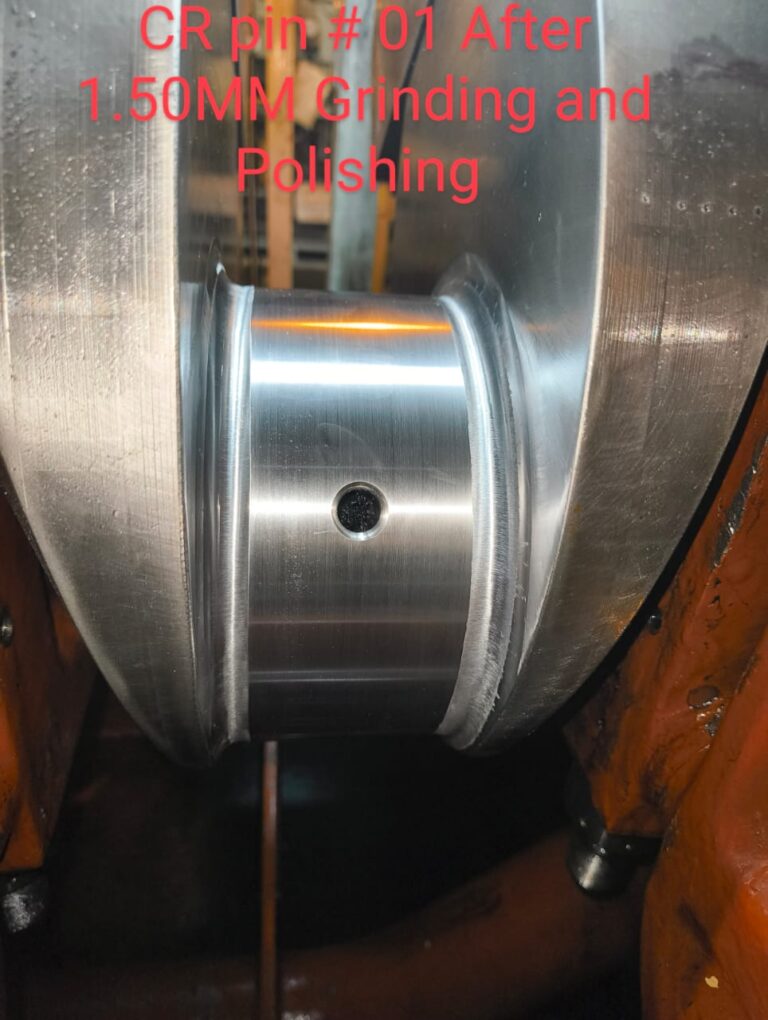
In December 2024, RA Power Solutions successfully repaired a Himsen Hyundai 6H17/28 crankshaft on a vessel anchored at MIP Mersin, Turkey. The Italian-owned ship experienced a major breakdown in one of its auxiliary engines due to lubricating oil pump failure, which damaged all connecting rod bearings. Upon inspection, technicians found bearing material embedded in all six crankpins, with taper and ovality measurements ranging from 0.22 mm to 0.86 mm. Technicians also detected minor hairline cracks. Using in situ crankshaft grinding equipment, the team reduced the diameters of the crankpins by 1.00 mm to 1.50 mm, restoring them to operational standards.
Therefore, this case clearly highlights why in-situ crankshaft grinding and on-site crankshaft repair services continue to be the preferred choice for shipowners and marine engineers, especially when they are facing unexpected engine breakdowns.
Why This Repair Was Critical
Initially, the auxiliary engine’s lubricating oil pump failed, which consequently caused extensive damage to the connecting rod bearings. As a result, bearing material was found embedded in all six crankpins, ultimately leading to significant taper and ovality beyond acceptable limits.
Without timely intervention, this damage could have led to further engine failure, extended downtime, costly workshop overhauls, or even disassembly of the entire engine block — all of which are highly disruptive and expensive for commercial vessels.
On-Site Crankshaft Grinding: How It Works
Insitu crankshaft grinding uses state-of-the-art portable grinding machines that are brought directly to the vessel. Technicians perform precision grinding and polishing of crankpins and journals without the need to remove the crankshaft.
Key benefits include:
- Fast turnaround and reduced vessel downtime
- No dismantling or transportation of the crankshaft
- Restoration of OEM-compliant dimensional tolerances
- Minimal interruption to vessel operations
- Cost-competitive compared to workshop repairs
These advantages make onsite machining one of the most efficient marine crankshaft repair solutions in the industry.
Before vs After: Dimensional Accuracy Restored
Before repair, crankpin taper and ovality ranged from 0.22 mm up to 0.86 mm, exceeding acceptable engine standards and risking further mechanical issues.
After precise in-situ grinding:
- Three crankpins were ground to a diameter of 174.00 mm
- Three additional crankpins were ground to 173.50 mm
- Final measurements had ovality within 0.02 mm, meeting strict OEM tolerances and ensuring long-term reliability.
This precise dimensional restoration demonstrates the accuracy of insitu crankshaft grinding technology.
Global On-Site Crankshaft Repair Capabilities
RA Power Solutions provides onsite crankshaft grinding and heavy engine repair services worldwide — from Turkey to the Middle East, South Asia, Africa, and beyond. Their teams are ready to respond quickly and efficiently, minimizing operational disruptions for shipping companies everywhere.
For a comprehensive overview of a similar repair, check out our latest blog post: Himsen Hyundai 6H17/28 Crankshaft Repair in Turkey.
For more information regarding crankshaft grinding services, onsite insitu crankshaft repair, crankshaft grinding and repair, grinding of onsite crankshaft repair, insitu crankshaft grinding repair, grinding of crankshaft onsite please contact us at rajshahani@rapowersolutions.com or info@rapowersolutions.com or call us at +91 9582647131 or +91 9810012383.
FAQs
The breakdown was due to a lubricating oil pump failure, which damaged the connecting rod bearings. And led to embedded bearing material on all six crankpins.
Before repair, taper and ovality on the crankpins ranged from 0.22 mm up to 0.86 mm, indicating significant wear and distortion.
RA Power Solutions operated in situ crankshaft grinding equipment directly aboard the vessel at MIP Mersin. And enabling them to grind and polish the crankpins without removing the shaft.
Our technicians ground down three crankpins by 1.00 mm to a final diameter of 174.00 mm. While they reduced the other three by 1.50 mm to reach 173.50 mm.
Yes. After grinding, all six crankpins achieved diameters with ovality within 0.02 mm, meeting OEM dimensional tolerances.